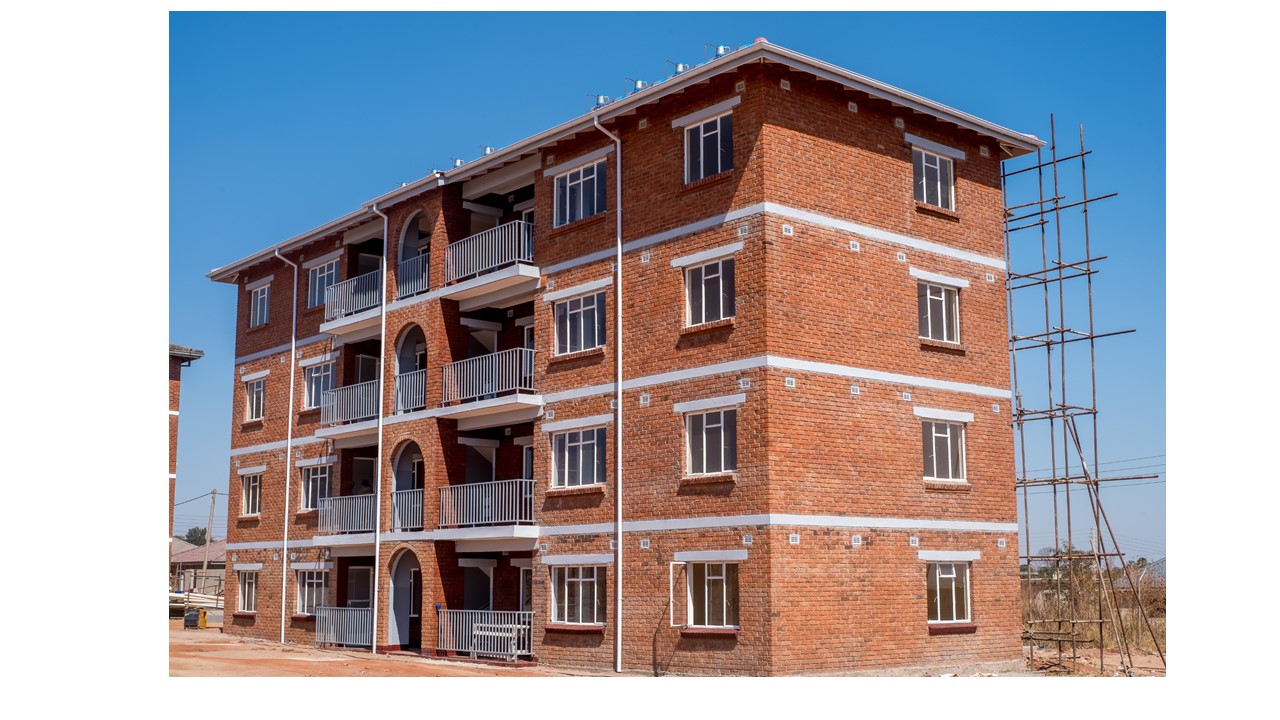

The Minister of National Housing and Social Amenities Hon Dr Zhemu Soda and the Deputy Minister Hon Musa Ncube leading with officials from FBC Holding during a tour of the Zvishavane Eastlea Housing Project.
Government has rolled out a multi-pronged strategy to improve access to housing finance for both developers and citizens, as it intensifies efforts to scale up housing delivery under the National Development Strategy 2 (NDS2).
In a wide-ranging interview with the Zimbabwe Broadcasting Corporation recently, the Minister of National Housing and Social Amenities Hon. Dr Zhemu Soda, said limited access to affordable capital remains the single biggest constraint to expanding housing delivery, prompting a comprehensive approach centred on de-risking the sector, creating innovative financial products, and leveraging partnerships with the private sector and development partners.
Hon. Dr. Soda said for developers, the Ministry is championing commercial joint ventures, under which the Government contributes land as equity while private partners bring in funding. Each party’s contribution is converted into shareholding, which is then used to share the proceeds from the housing development.
He added that Public-Private Partnerships (PPPs) will be adopted, particularly for off-site infrastructure development and the regeneration of government-owned properties. Under this model, private investors will recover their costs through a build, operate and transfer arrangement.
Hon. Dr. Soda said the Ministry is also engaging banks, pension funds and insurance companies to design tailored construction and development finance products aimed at unlocking long-term capital for housing projects, adding that for citizens and home buyers, the Government is focusing on improving access to mortgage and end-user finance.
The Minister said a key intervention is the revitalisation of the National Housing Fund (NHF), which the Ministry intends to transform into a fully functional revolving fund. The objective is to restore the NHF’s historical role in funding low-income housing projects, which was diminished following the disposal of a large portion of its assets.
Minister Soda added that efforts were also underway to revive the mortgage market through the resuscitation of the Housing Guarantee Fund, which provides Government-backed guarantees to individuals seeking mortgages from banks and building societies, thereby reducing lending risks.
The Minister explained that his Ministry is further exploring diverse tenure and financing options to cater for citizens who cannot access conventional mortgages. These include rent-to-buy schemes targeting low- to middle-income earners, as well as employer-assisted housing schemes. Under such arrangements, large employers — including Government, mining houses and agribusinesses — can provide loan guarantees, facilitate payroll-deducted mortgage repayments, or directly develop housing for their employees.
In line with NDS2’s emphasis on partnerships, his Ministry is working with international development partners and financial institutions such as the African Development Bank (AfDB), UN-Habitat and Shelter Afrique to come up with partnerships that are focused on technical assistance in designing sustainable housing finance models and exploring potential credit lines to support large-scale housing delivery.
Minister Soda said Zimbabwe’s decision to increase its shareholding in Shelter Afrique from 1.5 percent to 5 percent has important strategic implications for housing financing, particularly under NDS2. The move goes beyond equity participation and directly strengthens the country’s ability to mobilise affordable, long-term capital for housing delivery.
”A higher shareholding strengthens Zimbabwe’s standing as a shareholder country, improving access to Shelter Afrique’s concessional and long-term financing windows,” he said, adding that this would enable lower-cost loans for housing projects, longer repayment tenures suitable for housing development, and reduced pressure on short-term, expensive domestic borrowing.
With increased shareholding, Zimbabwean developers and public institutions, including local authorities and housing agencies, are better positioned to access these facilities on favourable terms.
“Ultimately, the move positions housing as a bankable economic sector rather than a purely social expenditure, enabling scaled-up delivery and improved home ownership over the NDS2 period,” said the Minister.
The Minister stated that the effectiveness of the measures would be reflected in increased housing delivery and improved homeownership rates over the NDS2 period, contributing to enhanced living conditions and inclusive national development, thereby fulfilling the objectives of Vision 2030.
Finance and Economic Development Minister Mthuli Ncube in his 2026 budget statement reiterated that the housing sector is recognized as a key driver of national economic growth. It remains one of the ten pillars under the NDS2, falling under the Infrastructure Development and Housing.